Meta Description: Discover what Post-Quantum Cryptography (PQC) is, why “Harvest Now, Decrypt Later” is a risk, and how new 2026 NIST standards protect your data from Q-Day.
The Digital Lock is Changing: Why You Need to Know PQC Today
Imagine you have a high-tech safe in your home that has been unhackable for 40 years. You keep your most private documents in it, confident that even the smartest locksmith couldn’t crack the code. Now, imagine a new type of “skeleton key” is being developed—one that doesn’t just pick the lock but understands the very atoms of the metal to walk right through the door.
This is the situation our digital world faces today. The “safe” is the encryption we use for every credit card swipe, WhatsApp message, and bank transfer. The “skeleton key” is the Quantum Computer.
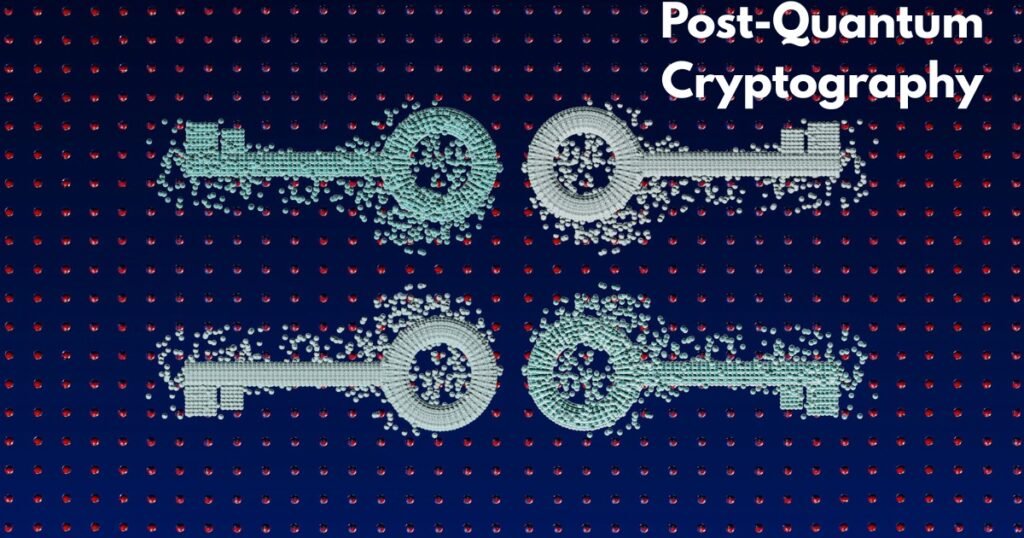
Post-Quantum Cryptography (PQC) is the new type of lock we are building today to make sure that even when those “skeleton keys” arrive, our digital safes remain impenetrable.
What is Post-Quantum Cryptography? (The 45-Second Answer)
Post-Quantum Cryptography refers to a suite of new mathematical algorithms designed to be secure against attacks from both today’s computers and future quantum computers. Unlike current encryption (like RSA or ECC), which a quantum computer could break in minutes, PQC uses complex geometric and algebraic problems that even quantum processors cannot solve efficiently.
The Threat: Why “Q-Day” and “HNDL” Matter Now
In the cybersecurity world of 2026, two acronyms dominate the conversation: Q-Day and HNDL.
-
Q-Day (or Y2Q): This is the hypothetical day when a quantum computer becomes powerful enough to break the RSA-2048 encryption that currently secures the internet. While experts once thought this was decades away, 2026 estimates suggest it could arrive as early as 2030 to 2035.
-
HNDL (Harvest Now, Decrypt Later): This is the most urgent reason for beginners to care. Sophisticated hackers and nation-states are currently stealing (harvesting) encrypted data from the internet today. They can’t read it yet, but they are saving it in massive data centers. When Q-Day arrives, they will use a quantum computer to decrypt your 2024 bank records, 2025 medical history, and 2026 private business contracts.
The Reality Check: If your data needs to remain secret for more than 10 years, it is already at risk. Your privacy is being “stolen” now to be revealed later.
How PQC Works: From Prime Numbers to Lattices
To understand how PQC works, we first have to look at why current encryption fails.
Why RSA and ECC are Vulnerable
Today’s security relies on Asymmetric Cryptography. This usually involves a math problem that is easy to do one way but nearly impossible to reverse. For example, multiplying two massive prime numbers is easy for a computer, but finding out which two primes were used (factoring) is incredibly hard.
In 1994, a mathematician named Peter Shor developed Shor’s Algorithm. He proved that a quantum computer could use “quantum bits” (qubits) to solve these factoring problems almost instantly.
The PQC Solution: New Math Families
PQC doesn’t use quantum physics (that’s something else called Quantum Key Distribution). Instead, PQC uses new types of math that quantum computers aren’t good at. The most common families in 2026 include:
-
Lattice-based Cryptography: Imagine a grid of billions of points in 500-dimensional space. The “math problem” is finding the point closest to a specific spot. It turns out that both classical and quantum computers find this nearly impossible to solve quickly.
-
Code-based Cryptography: Based on the difficulty of decoding a message that has had random errors intentionally added to it.
-
Hash-based Signatures: These use “one-way” functions that are extremely resistant to any kind of reverse engineering.
The 2026 Standards: FIPS 203, 204, and 205
The global authority on this transition is the National Institute of Standards and Technology (NIST). In 2024, they released the first official standards, which are now being legally mandated across industries in 2026.
| Standard | Technical Name | Former Name | Use Case |
| FIPS 203 | ML-KEM | CRYSTALS-Kyber | General encryption (Websites, VPNs) |
| FIPS 204 | ML-DSA | CRYSTALS-Dilithium | Digital Signatures (Authentication) |
| FIPS 205 | SLH-DSA | SPHINCS+ | Backup signatures (Ultra-high security) |
FIPS 206 (FALCON) is also in the pipeline for 2026, offering high-performance signatures for devices with very little memory.
The “Hybrid Mode” Strategy: Why We Don’t Switch All at Once
One of the biggest misconceptions is that we will just “turn off” RSA and “turn on” PQC. In reality, 2026 is the year of Hybrid Key Exchange.
Since PQC algorithms are still relatively new, cryptographers are worried there might be a “classical” bug in them that we haven’t found yet. To solve this, your browser and servers now use a “Double Wrap” method:
-
Your data is encrypted with a standard, proven method like X25519 (Classical).
-
It is then encrypted again with ML-KEM (Post-Quantum).
Even if a hacker breaks the PQC part with a clever new math trick, they still can’t get past the classical part. If they have a quantum computer to break the classical part, they still can’t get past the PQC part. You get the best of both worlds.
The Impact on Your Devices: Mobile and IoT
Many beginners ask: “Will PQC slow down my phone?”
The short answer is: Probably not for you, but yes for the hardware.
PQC keys and digital signatures are much larger than the ones we use now. For example, an RSA signature might be 256 bytes, whereas a PQC signature can be 2,400 bytes or more.
-
Bandwidth: Webpages take slightly more data to load (a few extra kilobytes).
-
Battery Life: For your smartphone, the impact is negligible. However, for tiny IoT (Internet of Things) devices like smart sensors or medical implants, the extra processing power required for PQC can reduce battery life by 5-10% if not optimized.
-
Latency: You might notice a few extra milliseconds of “handshake” time when connecting to a secure VPN in 2026.
How to Prepare: A 5-Step Beginner’s Roadmap
If you are an IT manager or a business owner, the “Wait and See” approach ended in 2025. Here is the 2026 industry-standard checklist for Quantum Readiness:
-
Inventory Your Assets: You can’t protect what you don’t know you have. Create a “Cryptographic Bill of Materials” (CBOM) to list all the places your company uses encryption.
-
Assess the Lifetime of Your Data: Does your data need to be secret for 10+ years? If yes, it is your highest priority for migration.
-
Prioritize “External” Connections: Start by updating your VPNs and web-facing servers to support NIST-standardized algorithms (ML-KEM).
-
Adopt Crypto-Agility: When buying new software, ask the vendor: “Can I swap the encryption algorithm without rebuilding the entire app?” This is called Crypto-Agility.
-
Test the Hybrid Approach: Don’t go 100% PQC yet. Implement hybrid tunnels to maintain compliance with older systems while gaining quantum protection.
Common Myths About PQC
-
Myth 1: “I need a quantum computer to use PQC.”
-
Truth: PQC is just software. It runs on the laptop or phone you are using right now.
-
-
Myth 2: “AES-256 is broken by quantum computers.”
-
Truth: Not exactly. While quantum computers can use Grover’s Algorithm to speed up attacks on AES, simply using longer keys (AES-256 instead of AES-128) keeps it secure.
-
-
Myth 3: “Blockchain and Bitcoin are dead because of PQC.”
-
Truth: Most blockchains will need to “hard fork” to update their signature math, but the technology to protect them (ML-DSA) already exists.
-
Frequently Asked Questions (PAA)
Is Post-Quantum Cryptography the same as Quantum Cryptography?
No. Post-Quantum Cryptography (PQC) is software-based math that runs on normal computers. Quantum Cryptography (like QKD) uses the physical properties of light and requires specialized hardware like lasers and fiber optics.
When is “Q-Day”?
Current industry consensus suggests that a “Cryptographically Relevant Quantum Computer” (CRQC) could appear between 2030 and 2035.
Which NIST algorithm is the best for beginners?
ML-KEM (formerly Kyber) is the gold standard for general encryption. It is fast, efficient, and has been thoroughly vetted by NIST as part of the FIPS 203 standard.
Does PQC affect my password security?
Standard passwords stored with “hashes” (like SHA-256) are already quite resistant to quantum attacks. PQC primarily focuses on Public-Key encryption, which protects data as it travels across the internet.
Will I have to buy new hardware for PQC?
In 90% of cases, no. PQC is a software update. However, very old “legacy” hardware that has encryption hard-coded into its chips may need to be replaced.
How much does PQC migration cost?
For a small business, the cost is hidden in the price of updating your software (Microsoft 11, Google Chrome, etc.). For large enterprises, a full PQC migration can cost millions and take 3–7 years to complete.
Is my data safe if I use a VPN?
Only if the VPN provider has implemented “Quantum-Resistant” tunnels. In 2026, most major providers (ExpressVPN, NordVPN, Mullvad) have already added support for PQC-hybrid connections.
Conclusion:
The transition to Post-Quantum Cryptography is one of the largest technical overhauls in the history of the internet. It is the “Y2K” of our generation, but with much higher stakes. By understanding the “Harvest Now, Decrypt Later” threat and moving toward NIST-standardized algorithms like ML-KEM, we aren’t just updating software—we are ensuring that the digital world we build today remains private for decades to come.