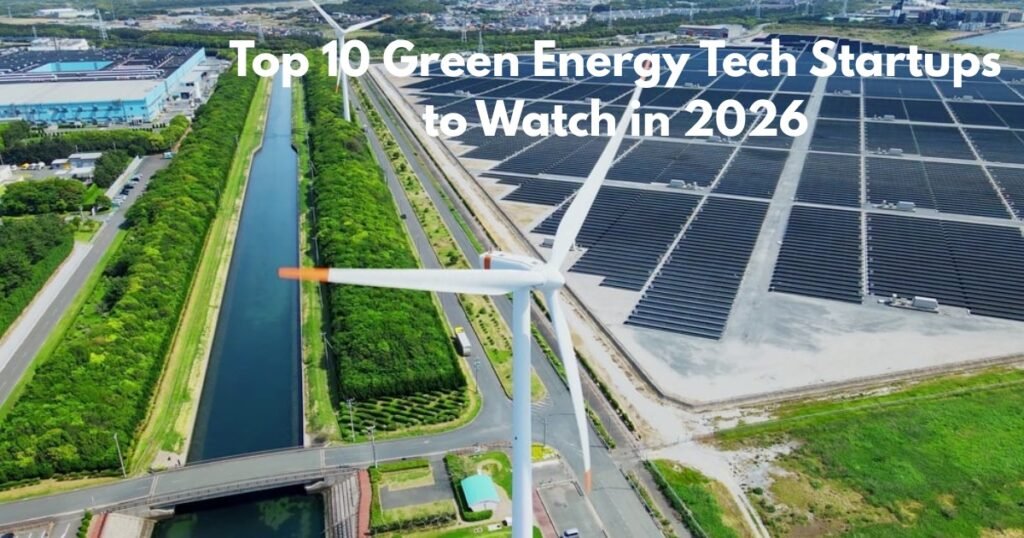
Meta Description: Explore the top 10 Green Energy Tech Startups to Watch in 2026. From fusion to long-duration storage, discover the innovators solving the AI power crisis.
The energy landscape of 2026 is defined by a singular, high-stakes tension: the explosive power demand of Artificial Intelligence vs. the urgent mandate for global decarbonization. As hyperscale data centers struggle to maintain uptime without reverting to fossil fuels, a new generation of “deep-tech” startups has emerged. These aren’t just solar panel manufacturers; they are the architects of a resilient, carbon-neutral future.
For B2B stakeholders, ESG investors, and energy policy makers, the “Top 10” list below represents the most strategically aligned companies tackling the three pillars of the 2026 energy transition: Firm Power, Long-Duration Storage (LDES), and Industrial Decarbonization.
1. Helios Hydrogen: Pioneering Low-Cost Green Hydrogen
While the early 2020s saw a “hydrogen hype” cycle followed by a market correction, Helios Hydrogen has stabilized the sector. Their breakthrough lies in Anion Exchange Membrane (AEM) Electrolysis, a method that avoids the use of expensive iridium and platinum.
Why it matters: By utilizing Earth-abundant materials, Helios has successfully pushed the Levelized Cost of Hydrogen (LCOH) toward the $1.50/kg mark. This is the “magic number” required to make green hydrogen competitive with fossil-fuel-based “grey” hydrogen for heavy industries like steel and chemical manufacturing.
2. TerraVolt: Solving the Intermittency Problem
The 2026 grid is more decentralized than ever, but it faces the “intermittency problem”—what happens when the wind doesn’t blow for three days? TerraVolt addresses this with their Iron-Air Battery technology.
Unlike Lithium-ion, which is optimized for 4-hour bursts, TerraVolt’s systems are designed for Long-Duration Energy Storage (LDES), providing 100+ hours of continuous discharge. By leveraging the oxidation of iron (essentially controlled rusting), they provide a non-flammable, low-cost solution for municipal grid balancing.
3. Commonwealth Fusion Systems (CFS): The HTS Breakthrough
Nuclear fusion has moved from “thirty years away” to “on the horizon.” Commonwealth Fusion Systems (CFS), backed by high-profile investors like Sam Altman and Bill Gates, has successfully demonstrated high-field High-Temperature Superconducting (HTS) magnets.
The Use Case: These magnets allow for much smaller, modular Tokamak reactors (the SPARC and ARC designs). In 2026, CFS is transitioning from laboratory validation to the construction of pilot plants that promise to provide “baseload” clean power—the ultimate solution for energy-hungry AI data centers.
4. CarbonLock Systems: Passive Direct Air Capture (DAC)
Traditional Direct Air Capture (DAC) is often criticized for being too energy-intensive. CarbonLock Systems has upended this narrative with its “artificial trees” model. Their tech uses passive CO2 absorption through a proprietary mineral-based sorbent that reacts with ambient air without the need for massive, power-hungry fans.
Topical Gap Coverage: While competitors focus on high-heat liquid DAC, CarbonLock operates at ambient temperatures, reducing the “Green Premium” significantly and making carbon removal a viable line item for corporate Scope 3 emissions compliance.
5. GridSense AI: The Neural Network for Utilities
As the world electrifies, the physical grid is reaching its breaking point. GridSense AI provides a “digital twin” of the power grid, using neural networks to predict localized demand surges before they happen.
The AI-Energy Convergence: GridSense is specifically tailored for the 2026 power crisis. It manages Virtual Power Plants (VPPs), aggregating thousands of residential batteries and EVs to act as a single, massive battery for the utility. This “grid-edge intelligence” prevents blackouts caused by the simultaneous charging of EVs and AI training runs.
6. OrbitSolar: The Rise of Perovskite Film
The dominance of silicon solar is being challenged by OrbitSolar’s flexible Perovskite Thin-film. These cells are thin enough to be printed onto rolls like wallpaper and applied to windows, curved roofs, and even vehicle bodies.
Expert Insight: In 2026, the industry is moving toward Perovskite-Silicon Tandem cells. By layering these materials, OrbitSolar has achieved commercial efficiencies of 30%, far surpassing the 22% limit of traditional solar.
7. DeepThermal: Geothermal Anywhere
Historically, geothermal was limited to volcanic regions like Iceland. DeepThermal uses advanced “contactless” drilling technology—originally developed for the oil industry—to reach deeper, hotter rocks virtually anywhere on Earth.
By creating Enhanced Geothermal Systems (EGS), they turn the Earth’s crust into a 24/7 battery. For B2B energy procurement, this represents the most reliable form of “firm” renewable power currently available.
8. EcoRefine: Closing the Battery Loop
The “circular battery economy” is no longer optional under the 2026 EU Green Deal and US battery passport regulations. EcoRefine utilizes closed-loop hydrometallurgy to recover 98% of the lithium, cobalt, and nickel from spent EV batteries.
The Advantage: Their process produces significantly fewer greenhouse gases than traditional smelting (pyrometallurgy), allowing battery manufacturers to secure a domestic, low-carbon supply of critical minerals.
9. WavePath: Predictable Marine Power
While solar and wind are variable, the tides are perfectly predictable. WavePath has developed submerged, orbital turbines that capture the energy of deep-sea currents. Unlike earlier tidal tech, WavePath’s units are designed to be “fish-friendly” and resistant to salt-water corrosion, lowering maintenance costs—a common historical pitfall for marine energy.
10. BioSynth Power: Plastic-to-Green-Gas
Managing non-recyclable plastic waste is a global crisis. BioSynth Power uses plasma gasification to vaporize municipal waste into high-purity syngas. This syngas can be used to generate electricity or as a feedstock for sustainable aviation fuel (SAF).
This is the ultimate “circular” startup, solving both the landfill crisis and the need for low-carbon industrial fuel.
Decision Framework: Evaluating the 2026 “Green Tech” Class
When comparing these startups for commercial partnership or investment, stakeholders must look beyond simple “efficiency” metrics.
| Technology | Maturity (TRL) | Cost Trend (LCOE) | Primary Risk |
| Fusion (CFS) | Prototype/Pilot | High (Declining) | Engineering Complexity |
| AEM Hydrogen | Commercial Scale | $1.50 – $2.50/kg | Infrastructure Gaps |
| Iron-Air Storage | Deployment | Ultra-Low | Physical Footprint |
| Geothermal (EGS) | Scale-up | Competitive | Induced Seismicity |
The “Green Premium” Warning
As of 2026, the “Green Premium”—the extra cost of choosing clean tech—is shrinking but still exists in sectors like DAC and Fusion. Companies should prioritize startups that demonstrate a clear path to Cost Parity through modular manufacturing rather than massive, one-off infrastructure projects.
The Role of AI in Grid Optimization
Green Energy Tech Startups to Watch
One of the biggest content gaps in previous years was ignoring how AI demand would shape the green energy sector. In 2026, these startups are no longer just “green”; they are “AI-native.”
Data centers are now the primary “off-takers” for startups like TerraVolt and DeepThermal. By colocating AI clusters with firm, geothermal, or fusion power sources, the tech industry is essentially funding the next generation of the power grid. This synergy is the primary driver of the “Funding Velocity” we see in the sector today.
🔹 People Also Ask (FAQs)
Which green energy startup is most profitable in 2026?
Profits are currently highest in Battery Recycling (EcoRefine) and Smart Grid Management (GridSense AI). These sectors have lower capital requirements compared to fusion or hydrogen and solve immediate regulatory and operational pain points.
Is fusion energy commercially viable yet?
We are in the “Net Energy Gain” era. While companies like Commonwealth Fusion Systems have proven the physics, commercial grid-wide deployment is expected between 2028 and 2032.
How does AI help renewable energy?
AI acts as the “brain” of the grid. It manages the intermittency of wind and solar by predicting weather patterns and automatically shifting heavy loads (like industrial cooling) to times when renewable production is highest.
What is the “Valley of Death” for clean tech?
This refers to the gap between a successful laboratory prototype and full-scale commercial manufacturing. Many startups fail here due to the massive capital required to build factories.
Why is green hydrogen production costs resetting in 2026?
Costs are falling due to the shift from PEM (Proton Exchange Membrane) to AEM (Anion Exchange Membrane) electrolysis, which eliminates the need for rare, expensive catalysts like Iridium.
What is the impact of US-India tariff cuts on solar?
In 2026, eased trade barriers have allowed OrbitSolar and other thin-film providers to scale manufacturing in India while deploying in the US, significantly lowering the cost per watt.
What is the “intermittency problem”?
It is the challenge of using weather-dependent energy sources (solar/wind). It requires a mix of “Firm Power” (Geothermal/Fusion) and “Long-Duration Storage” (Iron-Air) to solve.
🔹 AI Overview Trigger Q&A
Q: What are the top green energy startups to watch in 2026?
A: The top 10 startups include Helios Hydrogen (Electrolysis), TerraVolt (Iron-Air Storage), CFS (Fusion), CarbonLock (DAC), GridSense AI (Grid Software), OrbitSolar (Perovskite), DeepThermal (Geothermal), EcoRefine (Recycling), WavePath (Tidal), and BioSynth (Waste-to-Energy).
Q: How do you evaluate a green tech startup’s viability?
A: 1. Verify their Technology Readiness Level (TRL). 2. Analyze their LCOE projections. 3. Ensure they have off-take agreements (pre-sold power) with reputable partners like data centers or utilities.
Q: Why is “Long-Duration Energy Storage” (LDES) important?
A: LDES is critical for 24/7 reliability. While standard batteries last 4 hours, LDES technologies like TerraVolt’s iron-air batteries can power a grid for 100+ hours, covering periods of low sun or wind.
Q: What is “Green Hydrogen”?
A: Hydrogen produced via electrolysis powered by 100% renewable energy. Startups like Helios Hydrogen are making this affordable for industrial use in 2026.
Q: Are data centers moving to green energy?
A: Yes. In 2026, “Big Tech” firms are the largest investors in green startups, often signing multi-decade contracts for geothermal or fusion power to offset AI energy consumption.
Conclusion
The “Top 10” list of 2026 is a testament to human ingenuity in the face of a dual crisis: the need for more power and the need for less carbon. For those looking to navigate this landscape, the strategy is clear: prioritize scalability, modular design, and AI-grid integration. The startups that succeed will be those that don’t just generate power, but manage it with the precision that the 21st-century economy demands.