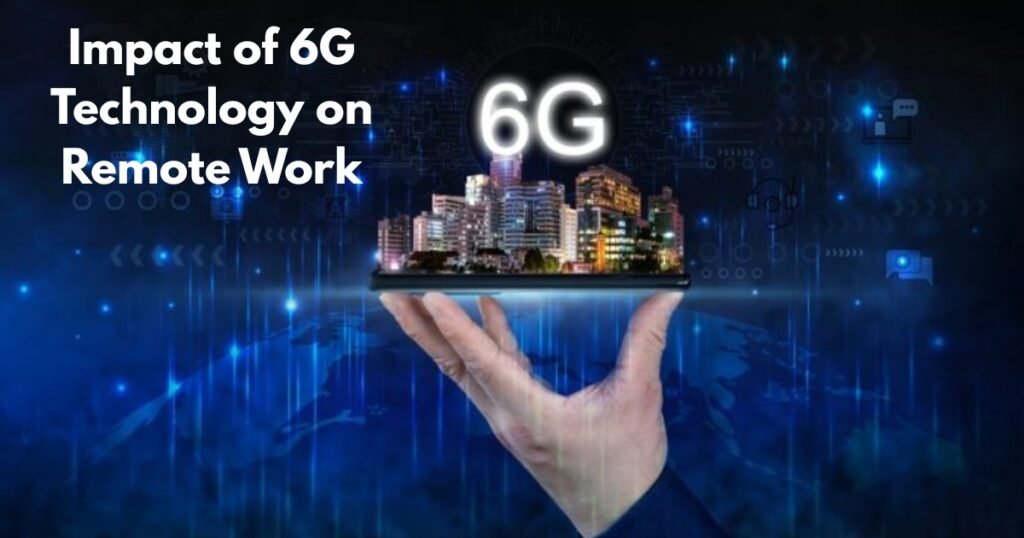
Meta Description: Discover how 6G technology will revolutionize remote work with 1 Tbps speeds, 3D holographic meetings, and the Internet of Senses. Impact of 6G Technology on Remote Work.
The transition from 4G to 5G was about speed; the leap from 5G to 6G is about presence. While 5G made video conferencing reliable, 6G (Sixth-Generation Wireless) aims to make the physical location of a worker entirely irrelevant. By the year 2030, the “remote” in remote work will no longer signify a distance, but a seamless digital extension of the self.
6G technology will enable data speeds up to 1 Tbps and sub-millisecond latency, allowing for high-fidelity 3D holographic presence and the Internet of Senses (IoS). This shifts the remote work paradigm from 2D screen-sharing to “tele-immersion,” where colleagues feel physically present in the same room regardless of global geography.
1. The Technical Pillars: Why 6G Changes the Game
To understand the impact on your home office, we have to look under the hood. 6G operates on the Terahertz (THz) spectrum (100 GHz to 3 THz), a frequency range previously untapped for mobile communications.
Speed and Latency: The End of the “Lag”
In a 5G world, we measure latency in milliseconds. In 6G, we move to microseconds. This is critical for Spatial Computing. When you move your head in a VR headset or manipulate a digital twin, the network must respond faster than the human brain can perceive a delay.
| Metric | 5G Performance | 6G Target (IMT-2030) | Remote Work Utility |
| Peak Data Rate | 20 Gbps | 1 Tbps | Instant sync of terabyte-scale architectural files. |
| Latency | 1–5 ms | < 0.1 ms | Real-time remote robotics and haptic feedback. |
| Connection Density | 1M devices/km² | 10M devices/km² | Hyper-dense smart home offices with 100+ sensors. |
| Reliability | 99.999% | 99.99999% | “Always-on” mission-critical remote operations. |
2. From Video Calls to 16K Holographic Presence
“Zoom fatigue” is largely a result of the brain struggling to process 2D non-verbal cues. 6G solves this through Holographic Communication.
Using Joint Communication and Sensing (JCAS), 6G base stations don’t just send signals; they “see” the environment. The network can map your physical movements in your home office and project a photorealistic 3D avatar into a boardroom halfway across the world.
Key Use Case: The Immersive Boardroom
-
Spatial Audio: Voices come from the direction of the person speaking in the virtual space.
-
Eye Contact: 6G’s high-resolution data allows for micro-expression tracking, restoring the “humanity” missing from current telecommuting.
-
Tele-immersion: HR directors can conduct interviews in a shared virtual park, feeling the “vibe” of a candidate as if they were sitting on the same bench.
3. The Internet of Senses (IoS) and Haptic Feedback
The most radical shift in remote work involves the Internet of Senses. This technology incorporates touch, and potentially smell/taste, into the digital workflow.
Through Haptic Feedback wearables, a remote surgeon or a mechanical engineer can “feel” the resistance of a scalpel or a wrench. For the average office worker, this means “feeling” the texture of a digital fabric sample or the weight of a virtual prototype.
Who is this for?
-
Precision Engineering: Adjusting factory machinery from a different continent.
-
Remote Healthcare: Tactile physical examinations performed via 6G-connected robotics.
-
Creative Design: Collaborative 3D modeling where designers “touch” their digital sculptures.
4. Closing the Digital Divide: Ubiquitous Connectivity
Currently, remote work is a luxury of the urban and suburban elite. 6G aims to kill the “rural internet” excuse through Non-Terrestrial Networks (NTN).
By integrating LEO (Low Earth Orbit) satellites and HAPS (High Altitude Platform Stations) directly into the cellular fabric, 6G provides 100% global coverage. Whether you are in a high-rise in London or a mountain hut in the Andes, your connection remains a 1 Tbps powerhouse.
The GEO-Aware Advantage-Impact of 6G Technology on Remote Work
For businesses, this means the talent pool is no longer restricted by fiber-optic maps. You can hire the best developer in a rural village without worrying about a dropped connection during a critical deployment.
5. Decision Framework: A 6G Readiness Scorecard for Businesses
Is your organization ready for the 2030 shift? Use this framework to evaluate your current trajectory.
| Capability | Current (5G) Status | 6G Preparation Step |
| Cybersecurity | Traditional VPN/Encryption | Transition to Quantum-Resistant Cryptography. |
| Hardware | 2D Laptops/Tablets | Pilot AR/VR spatial computing workflows. |
| Networking | Centralized Cloud | Invest in Edge-AI and decentralized processing. |
| Sustainability | High power consumption | Shift to Zero-Energy IoT sensors (backscatter). |
6. The “Human Angle”: Fixing Presence Disparity
One of the biggest failures of the current remote work model is “presence disparity”—the phenomenon where people in the physical office have more influence than those on a screen.
6G levels the playing field. When everyone is a high-definition hologram with haptic capabilities, the “distance” between a local and remote employee disappears. This will likely lead to:
-
The Death of the Commute: When “being there” is digitally perfect, the economic and environmental cost of commuting becomes unjustifiable.
-
Hyper-Personalized Workspaces: Your 6G home office can “skin” your environment to look like any office in the world, maintaining brand culture without the rent.
7. Risks and Warnings: The Spatial Attack Surface
With great connectivity comes a new breed of security risks. Because 6G uses sensing to map environments, your home office becomes part of the data stream.
-
Privacy Warning: If a network can “sense” your room to build a hologram, that spatial data must be encrypted. Without Quantum-Safe Cryptography, bad actors could virtually “walk through” your home.
-
AI-Native Vulnerabilities: Since 6G networks are managed by AI, “adversarial AI” attacks could potentially shut down entire distributed workforces in seconds.
Entity Glossary
-
Terahertz (THz): High-frequency waves that allow for massive data throughput but have short range.
-
O-RAN (Open Radio Access Network): A non-proprietary version of RAN that allows different vendors’ equipment to work together.
-
Digital Twin: A real-time virtual mirror of a physical object, used in 6G for remote troubleshooting.
-
3GPP & ITU: The international bodies setting the standards for what “6G” actually is (IMT-2030).
People Also Ask (FAQs)
1. Is 6G just “faster 5G”? No. While it is faster, its core innovation is sensing. 6G turns the network into a giant radar that can see and feel the environment, enabling 3D holographic presence.
2. Will I need to buy new devices for 6G? Yes. 6G requires specific THz transceivers and AI-native chips that are not present in current 5G smartphones or laptops.
3. When can I actually use 6G for work? Global standards (ITU-R) point toward a 2030 commercial launch, with initial pilot programs in tech hubs appearing around 2028.
4. Will 6G make office buildings obsolete? For many industries, yes. 6G removes the final barrier to remote work: the need for physical presence to maintain culture and high-stakes collaboration.
5. How does 6G help with “Zoom Fatigue”? It replaces flat video with 3D holograms and spatial audio, which aligns better with how the human brain processes social interaction, reducing cognitive load.
6. Is 6G safe for home use? 6G uses non-ionizing radiation. Standards bodies like IEEE and ICNIRP are currently establishing safety limits for THz frequencies to ensure they remain well below harmful levels.
7. Can 6G work without a line-of-sight? THz waves struggle with obstacles, but 6G uses Intelligent Reflecting Surfaces (IRS)—smart “mirrors” on walls that bounce signals around corners to maintain your connection.
Conclusion
The impact of 6G on remote work is nothing short of revolutionary. It transitions us from a “connected” society to an “entwined” one, where the digital and physical worlds are indistinguishable. For the global workforce, this means the end of geographical constraints, the death of the “remote worker” stigma, and the birth of a truly global, immersive talent marketplace.