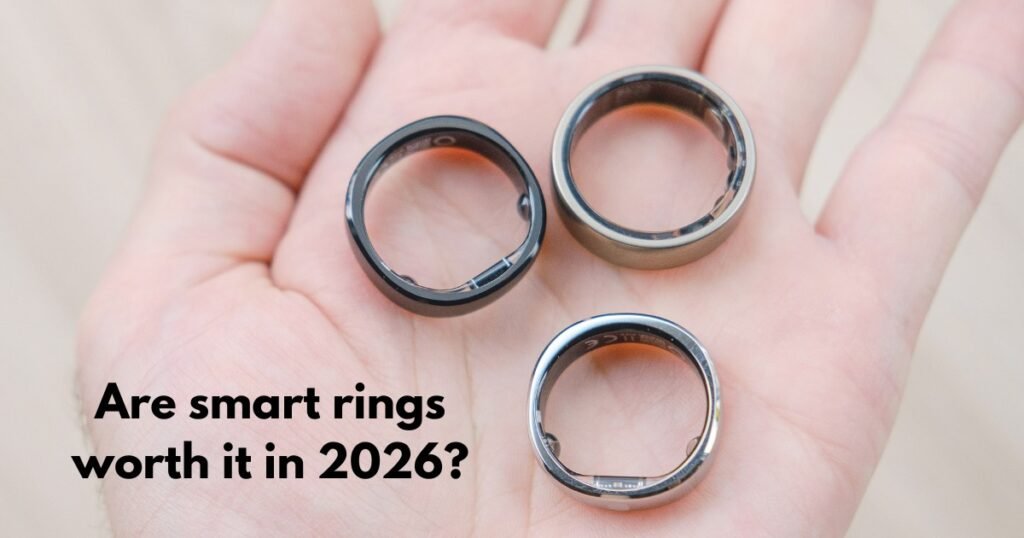
Meta Description: Are smart rings worth it in 2026. Compare Oura Gen 4, Samsung Galaxy Ring 2, and RingConn. Expert guide on health tracking, pricing, and 2026 tech.
For nearly a decade, the smartwatch has been the undisputed king of wearables. But by 2026, the tide has officially turned. The “screen fatigue“ era is here, and millions of users are migrating their health data from their wrists to their fingers.
The core question—are smart rings worth it in 2026?—no longer has a simple “yes” or “no” answer. Instead, it depends on whether you value a discreet “set and forget” health companion over the buzzing, high-interaction experience of a traditional watch. In 2026, smart rings have matured into medical-grade diagnostic tools, but they come with unique trade-offs in durability, subscription costs, and ecosystem lock-in.
The 2026 Verdict: Who Are They For?
Yes, a smart ring is worth it if:
-
You prioritize sleep tracking and recovery metrics above all else.
-
You want to monitor health vitals (HRV, $SpO_2$, temperature) without a glowing screen.
-
You are a “biohacker” or athlete using Energy Scores to dictate your training intensity.
-
You want a secondary device that looks like high-end jewelry.
No, a smart ring is likely not for you if:
-
You need GPS tracking for long-distance running or cycling.
-
You want to read and reply to texts from your wearable.
-
You are a heavy weightlifter (unless you use a protector or remove the ring).
-
You are unwilling to deal with the “sizing kit” logistics.
1. The 2026 Tech Landscape: What’s Actually New?
The smart rings of 2026 are a far cry from the experimental bands of 2022. We have seen a massive leap in sensor miniaturization and power efficiency.
Medical-Grade Health Monitoring-Are smart rings worth it in 2026
The most significant evolution in 2026 is the integration of non-invasive blood pressure trends and Metabolic Health tracking. Brands like Ultrahuman and RingConn Gen 3 now offer insights into how your body processes glucose and how your blood pressure fluctuates throughout the day, using advanced photoplethysmography (PPG) sensors that analyze blood volume changes in the capillaries of your finger.
The Productivity Shift: Gesture & AI Control
Smart rings are no longer just passive data loggers. In 2026, they have become “productivity companions.”
-
Gesture Control: Using the Matter Protocol, you can now “double-pinch” or flick your finger to dim smart lights, scroll through a presentation, or even trigger your phone’s camera.
-
AI Meeting Transcriptions: Specialized rings like the Vocci AI Ring now feature tiny, high-fidelity microphones that can record and summarize meetings directly into your cloud notes using Large Language Models (LLMs).
2. Comparison: Oura vs. Samsung vs. The “No-Subscription” Challengers
The market in 2026 is split into two distinct camps: the “Polished Ecosystems” (Subscription-based) and the “Value Disrupters” (One-time purchase).
Oura Ring Gen 4: The Gold Standard
Oura remains the most accurate device for sleep staging, matching clinical polysomnography with roughly $53\%$ accuracy for deep sleep cycles—the highest in the consumer market.
-
Pros: Best-in-class app; “Oura Advisor” AI coaching; integration with Natural Cycles for pregnancy and period tracking.
-
Cons: The $5.99/mo subscription fee. This brings the 3-year Total Cost of Ownership (TCO) to approximately $565.
Samsung Galaxy Ring 2: The Android Powerhouse
If you are already in the Samsung ecosystem, this is the most logical choice. It utilizes Galaxy AI to provide an “Energy Score” that competes directly with Oura’s Readiness Score.
-
Key Advantage: No monthly subscription fee. It also features a unique concave design that helps prevent the surface scratches that plagued the first generation.
-
Restriction: It is strictly for Android users, with several key features (like AI health analysis) locked to Samsung-only devices.
RingConn & Ultrahuman: The Subscription-Free Biohackers
For those who suffer from “subscription fatigue,” RingConn Gen 3 and Ultrahuman Ring AIR are the 2026 winners.
-
RingConn Gen 3: Boasts an incredible 10–12 day battery life and includes a haptic vibration motor for real-time health alerts (e.g., high heart rate warnings).
-
Ultrahuman: Focuses on the “Metabolic Movie,” correlating your movement and sleep with caffeine intake and glucose levels.
2026 Pricing & Value Comparison Table
| Feature | Oura Gen 4 | Galaxy Ring 2 | RingConn Gen 3 | Ultrahuman AIR |
| Price (MSRP) | $349 | $399 | $299 | $349 |
| Subscription | $5.99/mo | $0 | $0 | $0 |
| Battery Life | 7-8 Days | 6-7 Days | 10-12 Days | 6 Days |
| Best For | Sleep Accuracy | Samsung Users | Battery/Budget | Metabolic Health |
3. The “Weightlifting” Problem: Durability and Safety
One of the biggest user fears in 2026 remains durability. Most smart rings are made of Grade 5 Titanium with a Diamond-Like Carbon (DLC) coating. While incredibly strong, they are not impervious to “knurling”—the rough texture on gym barbells.
Expert Advice for Gym Goers:
If you lift heavy, your ring will scratch. Furthermore, there is the risk of ring avulsion (where the ring gets caught on equipment). In 2026, many users either:
-
Swap the ring for a fitness band (like the Garmin Vivosmart) during workouts.
-
Use a silicone “ring protector” over the device.
-
Choose the Brushed Titanium finish, which hides micro-scratches better than the “Stealth” or “Gold” finishes.
4. How to Buy: The Sizing Struggle
You cannot simply buy a smart ring and wear it the same day. Because the sensors must stay flush against your skin (specifically on the index or middle finger), a perfect fit is mandatory.
The 2026 Sizing Protocol:
-
Order a Sizing Kit: Most brands send this for free.
-
The 24-Hour Rule: Wear the plastic dummy ring for a full 24 hours. Your fingers swell at night and shrink in the cold.
-
Sensor Orientation: Ensure the interior bumps (the PPG sensors) are on the palm side of your finger. If the ring rotates too freely, your data (especially $SpO_2$) will be inaccurate.
5. Potential Pitfalls: Why You Might Regret It
Despite the hype, smart rings aren’t perfect.
-
Obsolescence: Rumors of an Apple Ring release in late 2026 are causing some iPhone users to wait. If Apple launches a ring, it will likely offer deeper iOS integration (Haptic notifications for iMessage) that third-party rings can’t match.
-
Sensor Accuracy on Skin Tones: While 2026 sensors have improved, some PPG technology still struggles with very dark skin tones or high-intensity exercise where the “noise” of movement disrupts the green/red light signals.
-
The “Charger” Problem: Unlike a universal USB-C cable, every ring has a proprietary charging cradle. If you lose it while traveling, your $350 ring becomes a paperweight until a replacement arrives.
People Also Ask (FAQs)
1. Can a smart ring replace my Apple Watch?
In 2026, it can replace it for health tracking but not for communication. If you need to see who is calling or navigate via GPS, you still need a watch. Many users now wear a mechanical watch during the day and a smart ring 24/7.
2. Is Oura Ring 4 worth it without a subscription?
Not really. Without the $5.99/mo fee, you only see three basic scores (Sleep, Readiness, Activity) without any of the deep data or AI coaching that makes the ring valuable. If you want a one-time payment, look at RingConn or Samsung.
3. Which finger should I wear my smart ring on?
The index finger is the gold standard for accuracy because it has the most accessible blood flow for the sensors. The middle finger is a close second. Avoid the pinky, as the bone structure is often too thin for consistent sensor contact.
4. Are smart rings waterproof for swimming?
Yes. Most 2026 models carry an IP68 or 10ATM rating, meaning they are safe for swimming, showering, and even shallow diving (up to 100 meters).
5. Do smart rings track blood pressure?
In 2026, they track blood pressure trends rather than providing a medical-grade systolic/diastolic reading. They are excellent for seeing how your BP changes in response to stress or caffeine but should not replace a doctor-prescribed cuff.
6. Will a smart ring scratch my phone?
Modern rings are made of titanium, which is harder than the glass on most phones. If you hold your phone in the same hand as your ring, you may see micro-abrasions on the phone’s frame over time.
7. How long do the batteries last before they need to be replaced?
Smart ring batteries are non-replaceable. You can expect about 3 to 4 years of life before the battery degradation makes the 7-day charge drop to 1–2 days.
Conclusion: The Final Decision
In 2026, the smart ring is no longer a luxury for tech-obsessed “biohackers”—it is a practical, powerful tool for anyone suffering from notification burnout.
Buy the Oura Gen 4 if you want the absolute best data and don’t mind the monthly fee. Buy the Samsung Galaxy Ring 2 if you are an Android user who wants a “buy once, own forever” experience. Choose RingConn or Ultrahuman if you want to push the boundaries of metabolic health and battery life.
The era of the “Screenless Wearable” has arrived. Whether it’s worth $300+ depends on how much you value knowing exactly what is happening inside your body while you sleep.